
A LocalCryptos clone script is ready-made software for launching a peer-to-peer (P2P) crypto exchange that works the way LocalCryptos did: buyers and sellers post ads, the coins sit in a non-custodial escrow, and the platform never holds user funds. This guide explains what the script includes, how its escrow works, how the exchange earns money, and what it takes to launch one in 2026.
It also covers something most clone script pages skip. LocalCryptos itself closed in November 2022, and LocalBitcoins and Paxful followed. Their stories show what a new P2P exchange needs to get right, so you can build on the model while avoiding the mistakes.
In this guide:
- What a LocalCryptos clone script is, and why LocalCryptos shut down
- How the non-custodial escrow moves coins and cash, step by step
- The user, admin and security features you should expect
- How the exchange makes money, with worked numbers
- Launch timelines, cost drivers and the 2026 rules to plan for
Launch Your Peer-to-Peer Exchange Faster with Our MVP System!
LocalCryptos Clone Script — built for speed & trust.
- MVP Ready: Go live 90% faster with our pre-built P2P engine.
- Escrow & Wallets: Secure crypto trades, no coding needed.
- Full Branding: Your logo, your tokens, your rules.
- Revenue Tools: Earn from escrow fees & premium listings.
Get your branded LocalCryptos-style demo in 48 hours for free.
Book a Free Demo to see how you can launch your P2P crypto exchange in just 8 – 12 weeks.
What Is a LocalCryptos Clone Script?
The LocalCryptos clone script is a pre-built, tailorable crypto exchange software that copies how the LocalCryptos platform worked. It comes with the core features, functions and plugins of LocalCryptos, so you can build a peer-to-peer crypto exchange quickly. The script uses escrow to protect each trade, which lets your users swap crypto assets safely. Like LocalCryptos, it supports the main coins people trade on P2P desks, such as Bitcoin, Ethereum, Litecoin, Dash and Bitcoin Cash, and you can add USDT and other stablecoins.
Coinsclone offers a ready LocalCryptos clone script that helps founders build a strong P2P crypto exchange at a sensible cost. Our clone scripts are fully designed, built, tested and ready to launch. Because the script is easy to customise, you can change it to fit your business goals and launch it as your own P2P crypto exchange. In short, you get a secure, fast and proven base for a premium trading experience.
What Was LocalCryptos, and Why Did It Close?
LocalCryptos began in 2017 as LocalEthereum, a P2P market for trading ETH. In November 2019 it rebranded as LocalCryptos and added Bitcoin, then Litecoin, Dash and Bitcoin Cash. Its big idea was simple: the platform never held anyone’s coins. For Bitcoin trades it used special escrow addresses on the blockchain, and for ETH it used a smart contract.
However, in October 2022 the team announced it was shutting down. New sign-ups stopped on 4 November 2022, and new trades stopped on 18 November 2022. The team gave three reasons: the bear market, the health of team members, and the cost of coming rules. Because the escrow was non-custodial, users kept control of their coins and could still reach their wallets after the close.
So why clone a platform that closed? The demand did not go away. People still want to buy crypto with local payment methods, often in places where banks block exchanges. What failed was the business around the software, not the escrow design. A new operator with a clear licence plan and a lean cost base can reuse the model that users liked.
Why Create a P2P Crypto Exchange Like LocalCryptos?
Users want privacy, control over their funds, low fees and flexible ways to pay. LocalCryptos met these needs, and that gap is now wider. Here are the key reasons to build a P2P crypto trading platform like LocalCryptos.
Big P2P venues have left the market
LocalCryptos closed in 2022, LocalBitcoins closed in February 2023, and Paxful ended operations on 1 November 2025 after serving more than 14 million users. Many of those traders moved to the P2P desks of large exchanges, but plenty of local markets still lack a focused, trusted P2P venue.
Lower running costs
You do not need custodial wallets or a central pool of liquidity. Traders bring their own coins and cash, so the cost to run a non-custodial P2P platform is much lower.
Global reach
A P2P crypto exchange works across borders. It lets more people trade in regions where banks limit access to centralised exchanges.
Several revenue streams
You can earn from trading fees, escrow fees, paid ads, dispute charges and premium user plans. We show the numbers later in this guide.
More trust among users
Smart contract escrow and private, encrypted chat build trust and make each trade transparent.
As a result, a P2P exchange like LocalCryptos can become a trusted gateway for direct crypto trading in 2026 and beyond.
Why a LocalCryptos Clone Script Wins Over Building From Scratch
The way you build decides how fast your P2P exchange grows. Here is why Coinsclone’s LocalCryptos clone script beats other methods.
- Tested and proven: The script already handles high volumes, many trades at once and many payment methods.
- Ready for market: Our ready-to-use white label crypto exchange software removes months of building and testing, so you can launch a P2P exchange like LocalCryptos sooner.
- Fully yours: Change the brand, UI and parts to fit your plans, and run the exchange as your own.
- Built with rules in mind: KYC, AML and audit tools are part of the design, which cuts legal and operating risk.
- Scalable: Add features and new countries as you grow, without rebuilding the core.
- Strong security: The non-custodial design and secure wallet keep each trade safe, which builds user trust.
- Head start: A P2P exchange built on a proven LocalCryptos clone script gets to market before ones built from scratch or on basic scripts.
Now, let’s look at the key features that make our LocalCryptos clone script stand out.
Essential Features of Our LocalCryptos Clone Script
The features you add decide how fast your user base and credibility grow. So, an up-to-date feature set matters for a P2P exchange like LocalCryptos. Here are the features that make our LocalCryptos clone script a premium choice.
User Features
These features improve the trading experience, remove friction and build trust. As a result, they keep users coming back to trade again.
- Buy/sell ads posting
- Escrow wallet
- Advanced proximity match
- Multiple payment acceptance
- Fiat wallet support
- Private chat
- Real-time trade statistics
- Multiple language support
Admin Features
Our admin features help you run the exchange well and stay safe, compliant and growing.
- KYC management
- Dispute resolution panel
- Commission history and settings
- P2P trading engine
- SMS integration
- Announcement system
Next, here are the features that harden your crypto exchange platform.
Security Features of Our LocalCryptos Clone Software
Security is our top priority. We build in strong security modules to protect our clone scripts from cyber threats and fraud. Here are the security features in our LocalCryptos clone scripts.
- Two-factor authentication
- Escrow protection
- Anti-DDoS (distributed denial of service) protection
- Jail login guard
- SSL integration
- End-to-end encrypted transactions
- HTTPS authentication
- Browser detection security
- Server-side request forgery protection
- CSRF protection
- Data encryption
Our crypto exchange clone scripts are built to handle real user volume, attacks and business growth.
Make Your Dreams Into Reality With Localcryptos Clone Script
Grab A Free Demo Now!
Add-On Modules Included In Our LocalCryptos Clone Script
We offer ready-to-plug add-ons that boost speed and user engagement on your P2P crypto exchange. Each add-on improves how your exchange works and gives you an edge.
- OTC trading module
- Crypto staking module
- Chatbot integration
- Automated KYC checks
- Token listing module
- Hardware wallet support
- Multi-chain support
With the features laid out, let’s see how the platform works in real time.
How Does the LocalCryptos Clone Script Work?
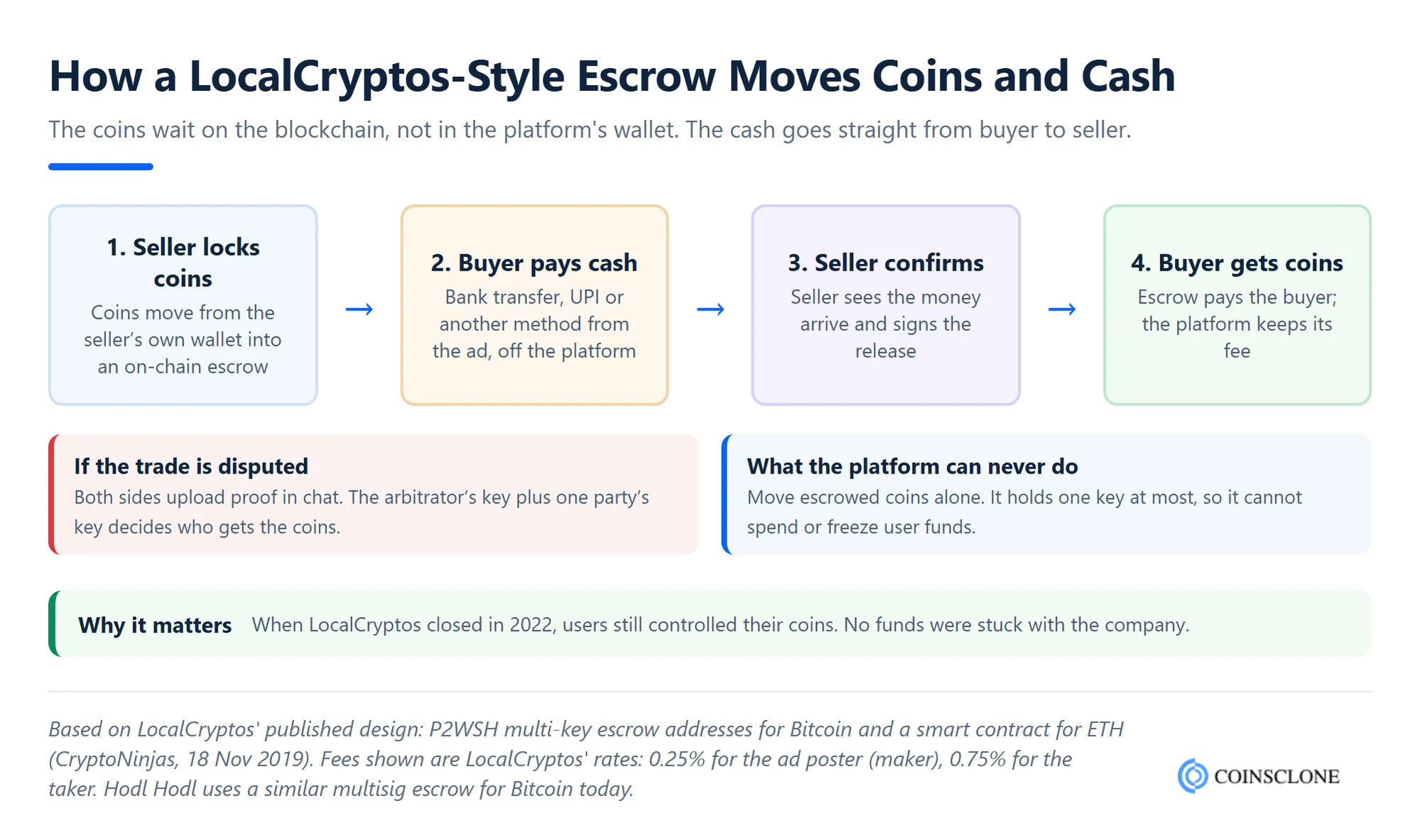
The LocalCryptos clone script runs a P2P crypto exchange where users trade directly with each other in a secure space. Escrow holds the seller’s coins during each trade, while the built-in non-custodial wallet keeps users in full control of their funds. Here is the full working process.
User Registration and Verification
- First, users sign up with an email address to create a trading account.
- After sign-up, the platform creates a secure, non-custodial wallet for the user in the LocalCryptos clone platform.
- Then, the user completes KYC checks with a government-issued ID (a driving licence or a passport) to start trading.
Trading Process
- Traders browse the ads that match what they want, or post their own buy or sell ads.
- Next, the platform lists the buyers or sellers for that coin (Bitcoin or Ethereum, for example) along with their payment options.
- Once the seller accepts the buyer’s deal, both sides can chat, and the coins are locked in escrow.
Payment and Completion
- The buyer sends the fiat money to the seller through the payment option named in the ad.
- After the seller confirms the payment, the escrow releases the crypto straight to the buyer’s wallet.
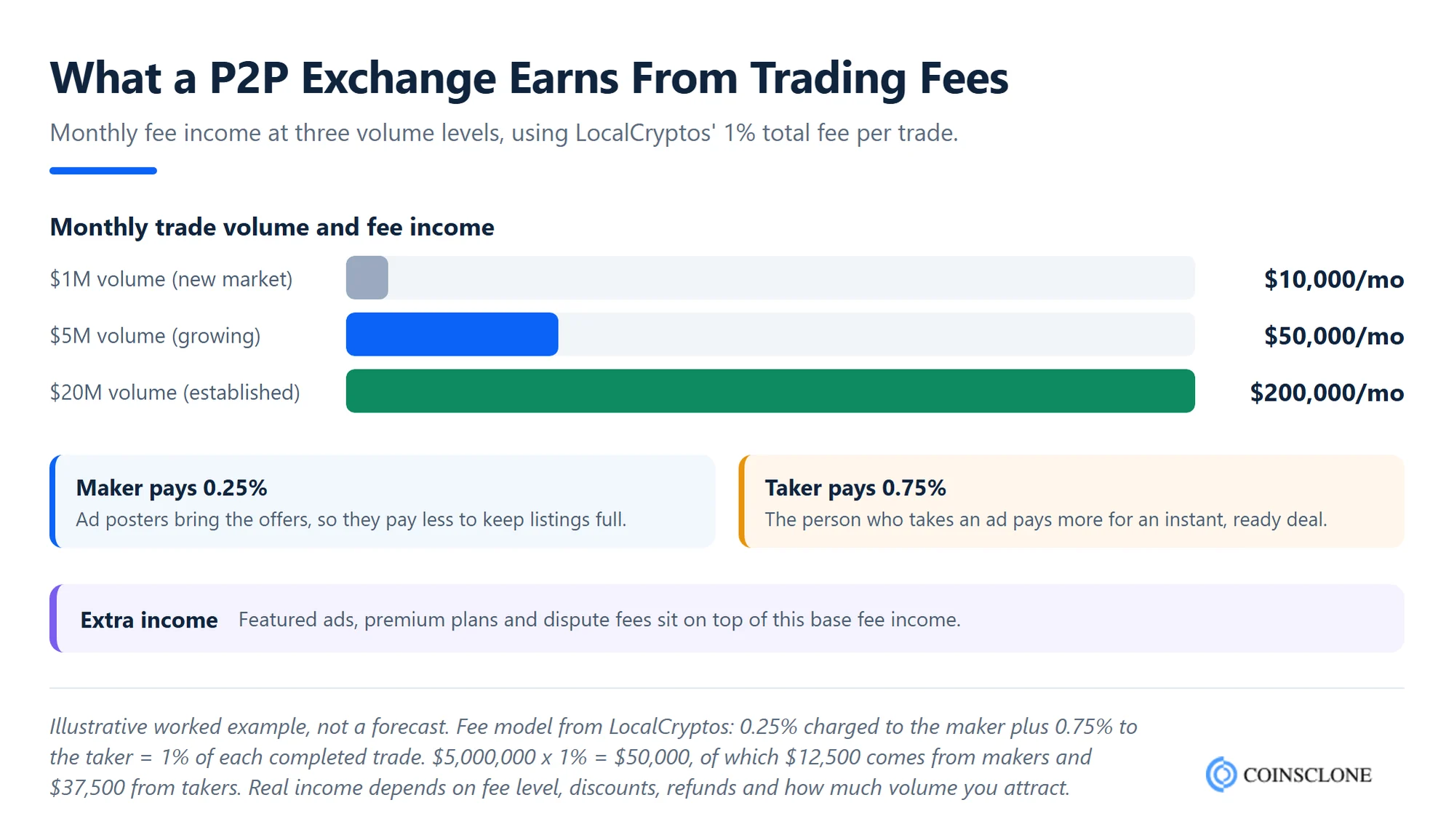
- As the exchange owner, you earn a fee on each completed trade. LocalCryptos charged 0.25% to the ad poster and 0.75% to the person who took the ad, so about 1% of every trade.
What makes the escrow non-custodial? LocalCryptos used special Bitcoin addresses (P2WSH) and an Ethereum smart contract for escrow. Each escrow needs more than one key to move the coins. The seller can release them to the buyer, but the platform cannot take them, and an arbitrator can only step in when a trade is disputed. Hodl Hodl, a non-custodial Bitcoin P2P venue still running in 2026, uses the same multisig idea. You can read more about the design in our guide to crypto escrow.
This is how our customisable LocalCryptos clone script works in the real world. Next, let’s look at what we deliver.
What We Deliver
At Coinsclone, we offer two ways to create a P2P crypto exchange like LocalCryptos easily and securely.
LocalCryptos Clone App
Traders want to trade on the go, so we build mobile apps for both Android and iOS. With our LocalCryptos Clone App, traders can buy, sell and trade crypto wherever they are.
We deliver a secure, scalable app with the core features of LocalCryptos, including private chat, a non-custodial wallet and escrow. A clean, simple UI makes the app easy to learn, which lifts engagement and sign-ups.
White Label LocalCryptos Clone Script
Our ready-to-launch White Label LocalCryptos Clone Script lets startups create a P2P crypto exchange like LocalCryptos fast. You can change the UI, branding, colours and theme, then launch under your own name with the core features of LocalCryptos.
The white label software includes strong admin controls for trades, disputes and users. By choosing our white label LocalCryptos clone script, you save time, money and effort, and you get a head start in the P2P crypto market.
Want to see it in action? Get your free demo now!
How a LocalCryptos-Style Exchange Makes Money
A P2P exchange earns from activity, not from holding funds. The main stream is the trading fee. LocalCryptos split it between the two sides of each trade, and many P2P venues still use that maker and taker model. On top of that, you can add a few optional streams.
- Trading fees: A small percentage on each completed trade, split between the ad poster (maker) and the person who takes the ad (taker).
- Featured ads: Traders pay to pin their offers at the top of busy markets.
- Premium plans: Lower fees, higher limits or faster support for power traders and merchants.
- Dispute fees: A charge on the losing side of a dispute, which also discourages bad behaviour.
- Add-on services: OTC desks, staking or token listings from the add-on modules above.
To see how the main stream scales, take the LocalCryptos rate of 1% in total per trade. The chart below shows the monthly fee income at three volume levels.
Keep in mind that P2P volume builds slowly. Each market needs enough active sellers before buyers stick around, so most new exchanges start with one country, a few payment methods and a small group of trusted merchants.
Business Perks of Using Our LocalCryptos Clone Script
Launching a P2P crypto exchange like LocalCryptos is a smart way to win market share. Our LocalCryptos clone script gives you a clear edge from day one. Here is what you gain.
| Benefits | What You Gain |
| Fast Market Entry | With our LocalCryptos clone script, a white label P2P exchange can go live in 4 to 8 weeks, and a standard build in 8 to 12 weeks. So you can enter the market and attract users sooner. |
| Lower Build Cost | You need fewer developers, less build time and less infrastructure, because the script already covers the core. |
| Several Revenue Streams | Our LocalCryptos clone software lets you earn from ads, escrow fees, premium features and trading fees. |
| Bigger User Base | The non-custodial wallet and escrow make users feel safe, which helps sign-ups and global growth. |
| Full Ownership | You get full control over your platform, including branding, trading rules and fee settings. |
| Rules and Security | Built-in KYC, layered security and strong admin controls make compliance easier as you grow. |
| Competitive Edge | You launch a P2P model that already proved it can attract traders who care about privacy, control and low fees. |
Coinsclone offers secure, scalable LocalCryptos clone software built for fast launch and long-term profit.
What Killed LocalCryptos, LocalBitcoins and Paxful: Lessons for 2026
The three best-known P2P marketplaces all closed within three years. None of them failed because the trading model stopped working. Instead, each one ran into cost, rules or both. The timeline below shows what happened.
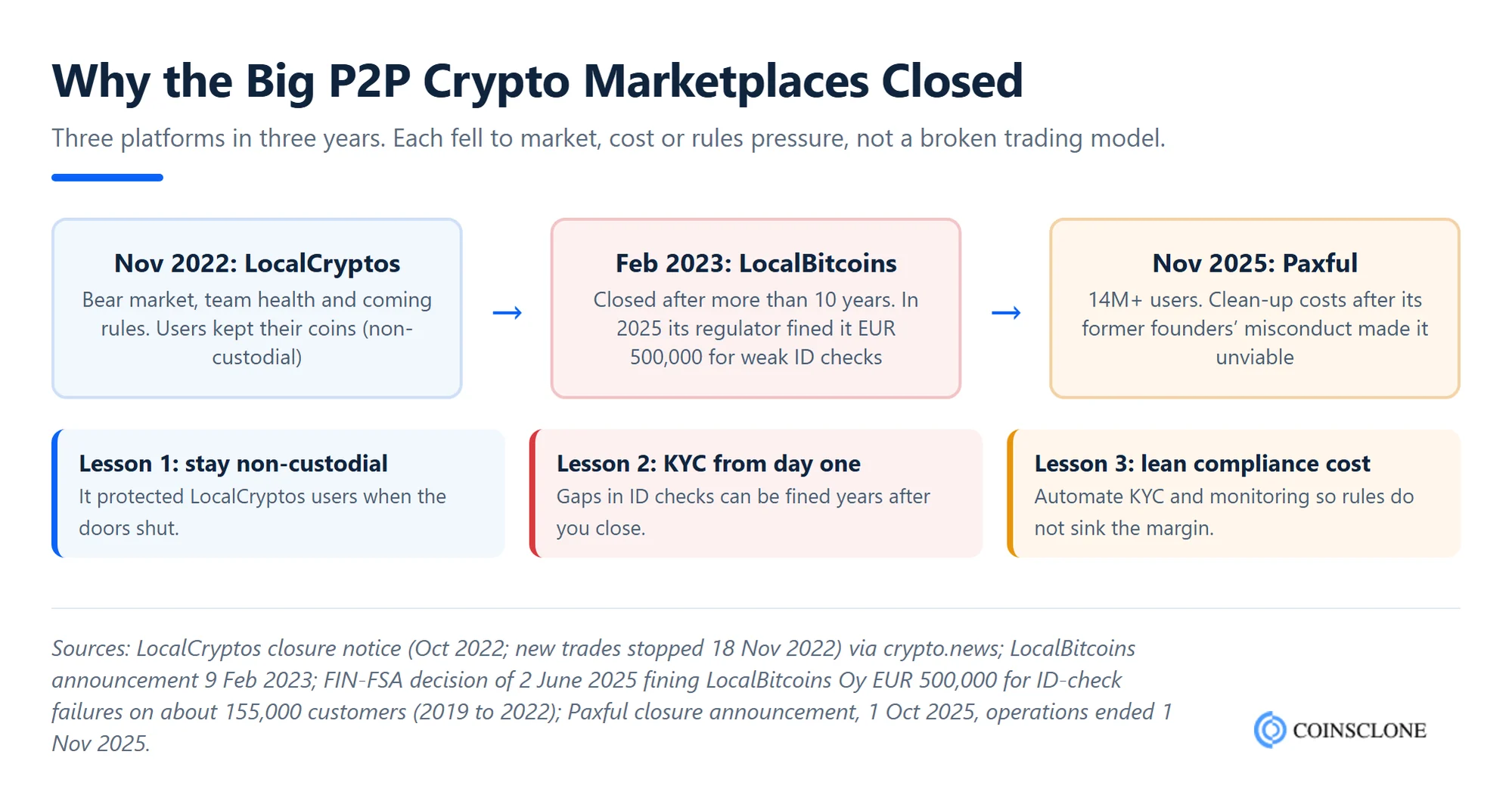
Here are the lessons a new P2P exchange should take from them.
- Plan your licence from day one: In June 2025, Finland’s regulator fined LocalBitcoins Oy EUR 500,000 for ID checks that failed on about 155,000 customers between 2019 and 2022. The fine landed more than two years after the platform closed.
- Keep running costs lean: Paxful said years of compliance clean-up after its former founders made the business too costly to run. Auto KYC and trade checks keep that cost low.
- Stay non-custodial where you can: When LocalCryptos closed, users still controlled their coins. That design protects users and limits your own risk.
- Pick your markets on purpose: Rules differ by country. Launch where you can get registered, then expand.
The Rules to Plan For in 2026
Under the FATF’s updated guidance on virtual assets, a business that runs a P2P platform can itself count as a virtual asset service provider (VASP). That means KYC, AML checks and Travel Rule data, even when the trades are peer to peer.
In the EU, MiCA now covers crypto firms, and the last grace periods ended on 1 July 2026. So any P2P exchange serving EU users needs a CASP licence. Our guide to launching a MiCA-compliant exchange covers that path. Other markets have their own rules, such as FIU registration in India and MSB registration with FinCEN in the US, so take local legal advice before launch.
How Long It Takes and What It Costs
Time to launch depends on how much you change the script. Coinsclone’s published timelines for P2P exchanges are:
- White label P2P exchange: 4 to 8 weeks
- Standard P2P exchange: 8 to 12 weeks
- Custom P2P exchange: 12 to 16 weeks
Cost follows the same pattern. These are the main things that move the price:
- Coins and chains: Each coin needs its own escrow logic, such as a multisig address for Bitcoin or a smart contract for Ethereum and USDT.
- Payment methods and countries: More local payment rails and languages mean more setup and testing.
- Mobile apps: Native Android and iOS apps add design, build and store review time.
- Compliance tools: KYC, AML screening and Travel Rule links are a must in most markets.
- Security audits: An outside audit of the escrow contracts is money well spent.
- Support after launch: Hosting, updates and dispute support are ongoing costs, not one-off ones.
For a fixed quote, share your target markets, coins and must-have features with our team.
How to Launch Your LocalCryptos Clone in 6 Steps
- Pick your market: Choose the country, coins and payment methods you will start with.
- Check the rules: Confirm the licence or registration you need there, and plan KYC and AML.
- Choose your build: White label for speed, or a custom build for unique features.
- Customise and brand: Set your fees, trade limits, payment methods, design and languages.
- Test and audit: Run full test trades, dispute drills and a security audit of the escrow.
- Launch and grow: Bring in trusted merchants first, then grow buyers with referrals and featured ads.
Launch a LocalCryptos-Like P2P Exchange Easily with Coinsclone!
Coinsclone is a leading cryptocurrency exchange script provider that has been building crypto platforms since 2018. We have delivered 350+ platforms for 200+ clients across 20 industries. Our team knows both the code and the crypto trade, and builds platforms that last.
Our LocalCryptos clone software goes beyond the basic features LocalCryptos offered. We also build other P2P exchange scripts, such as the LocalBitcoins clone script and Paxful clone script, as well as order book exchange scripts like the Bittrex clone and Poloniex clone. If you need a fully custom build, our P2P crypto exchange development team builds escrow-based exchanges from the ground up. Either way, our white label solutions let startups begin their crypto journey quickly and at a fair cost.
We provide:
- A fully customisable P2P exchange system
- Strong escrow and non-custodial wallet design
- Strong, enterprise-grade security
- Go-to-market support
- Round-the-clock technical and post-launch support
Ready to enter the P2P crypto market with a reliable exchange that drives revenue?
Launch Your Peer-to-Peer Exchange Faster with Our MVP System!
LocalCryptos Clone Script — built for speed & trust.
- MVP Ready: Go live 90% faster with our pre-built P2P engine.
- Escrow & Wallets: Secure crypto trades, no coding needed.
- Full Branding: Your logo, your tokens, your rules.
- Revenue Tools: Earn from escrow fees & premium listings.
Get your branded LocalCryptos-style demo in 48 hours for free.
Book a Free Demo to see how you can launch your P2P crypto exchange in just 8 – 12 weeks.
Frequently Asked Questions
What is a LocalCryptos clone script?
A LocalCryptos clone script is ready-made P2P crypto exchange software that copies the features of LocalCryptos. It lets startups launch an escrow-based P2P trading platform quickly and securely.
What happened to LocalCryptos?
LocalCryptos announced its closure in October 2022. It stopped new sign-ups on 4 November 2022 and new trades on 18 November 2022, citing the bear market, team health and coming rules. Because its escrow was non-custodial, users kept access to their own coins.
What is the difference between a clone script and custom development?
A clone script copies the proven features of an existing exchange, can be customised, and launches quickly. Custom development builds the exchange from scratch, which takes more time, money and people.
How long does it take to launch a P2P exchange like LocalCryptos?
With Coinsclone’s LocalCryptos clone script, a white label P2P exchange takes 4 to 8 weeks, a standard build 8 to 12 weeks, and a custom build 12 to 16 weeks. The final time depends on your features, coins and apps.
How much does a LocalCryptos clone script cost?
The price depends on the coins, payment methods, apps, security and add-ons you need. Coinsclone’s LocalCryptos clone scripts come in flexible packages for different business sizes, so share your scope for a fixed quote.
How does a P2P crypto exchange make money?
Most P2P exchanges charge a small fee on each completed trade. LocalCryptos charged 0.25% to the ad poster and 0.75% to the taker. Many platforms also sell featured ads, premium plans and add-on services.
Do you need a licence to run a P2P crypto exchange?
In most markets, yes. FATF guidance says the business running a P2P platform can count as a VASP, and EU platforms need a MiCA CASP licence. The rules differ by country, so get local legal advice before you launch.