
Not every crypto trade happens on a public order book. Funds, miners, brokers and wealthy traders often buy or sell in blocks of $50,000 or more, and a block that size can move the price on an open exchange. So they trade over the counter (OTC), where a desk quotes one firm price and settles the deal in private. An OTC crypto exchange script is ready-made software that lets you run that kind of desk under your own brand.
This guide explains what the script includes, how an OTC trade runs from quote to settlement, how a desk makes money, which licences apply in 2026, and how long a launch takes. You will also see current market data, so you can judge the business case before you talk to a team like ours.
In this guide:
- What an OTC crypto exchange script is, and how an OTC desk differs from an order-book exchange
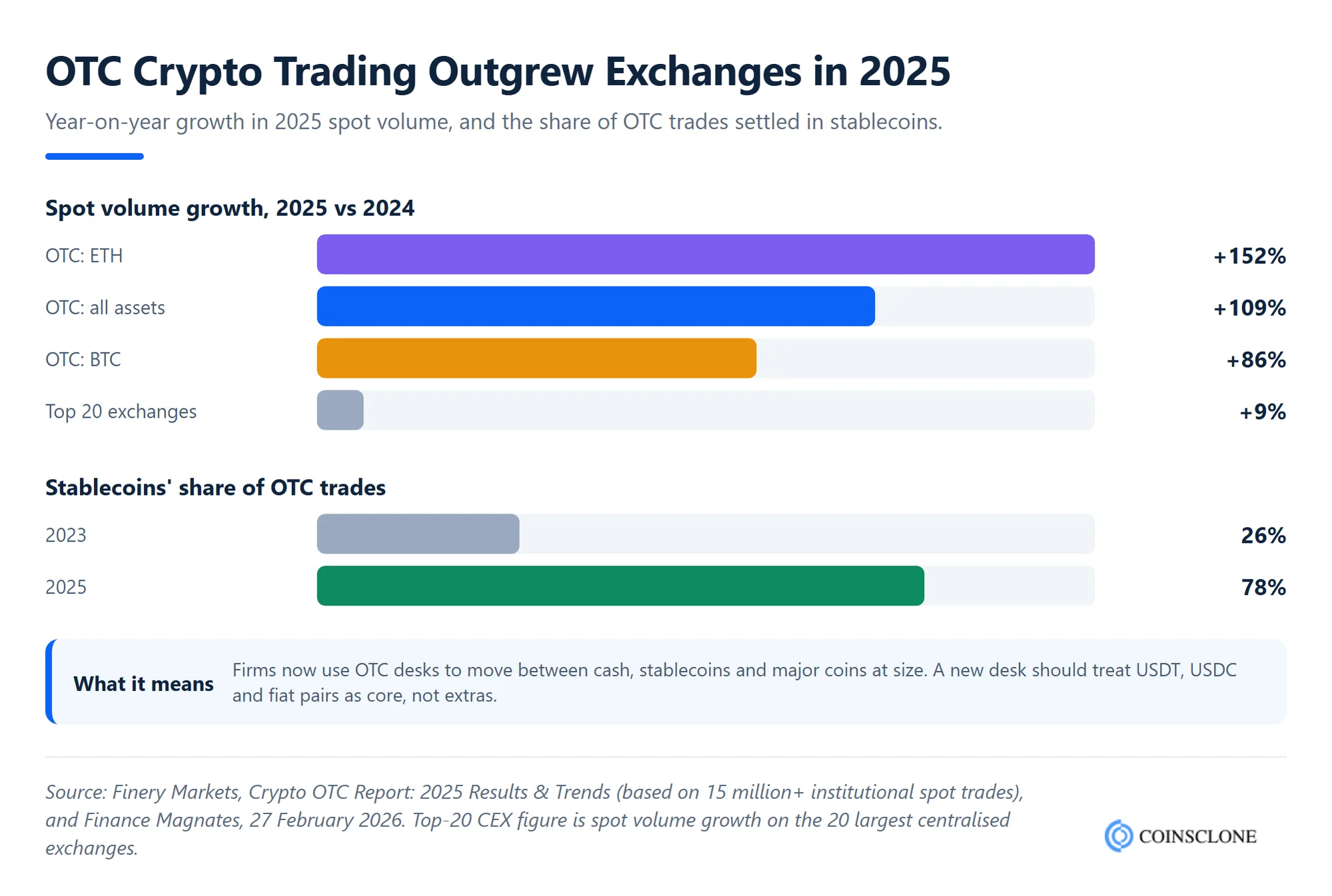
- Why OTC volume doubled in 2025 while big exchanges grew about 9%
- The features, security tools and settlement models a desk needs
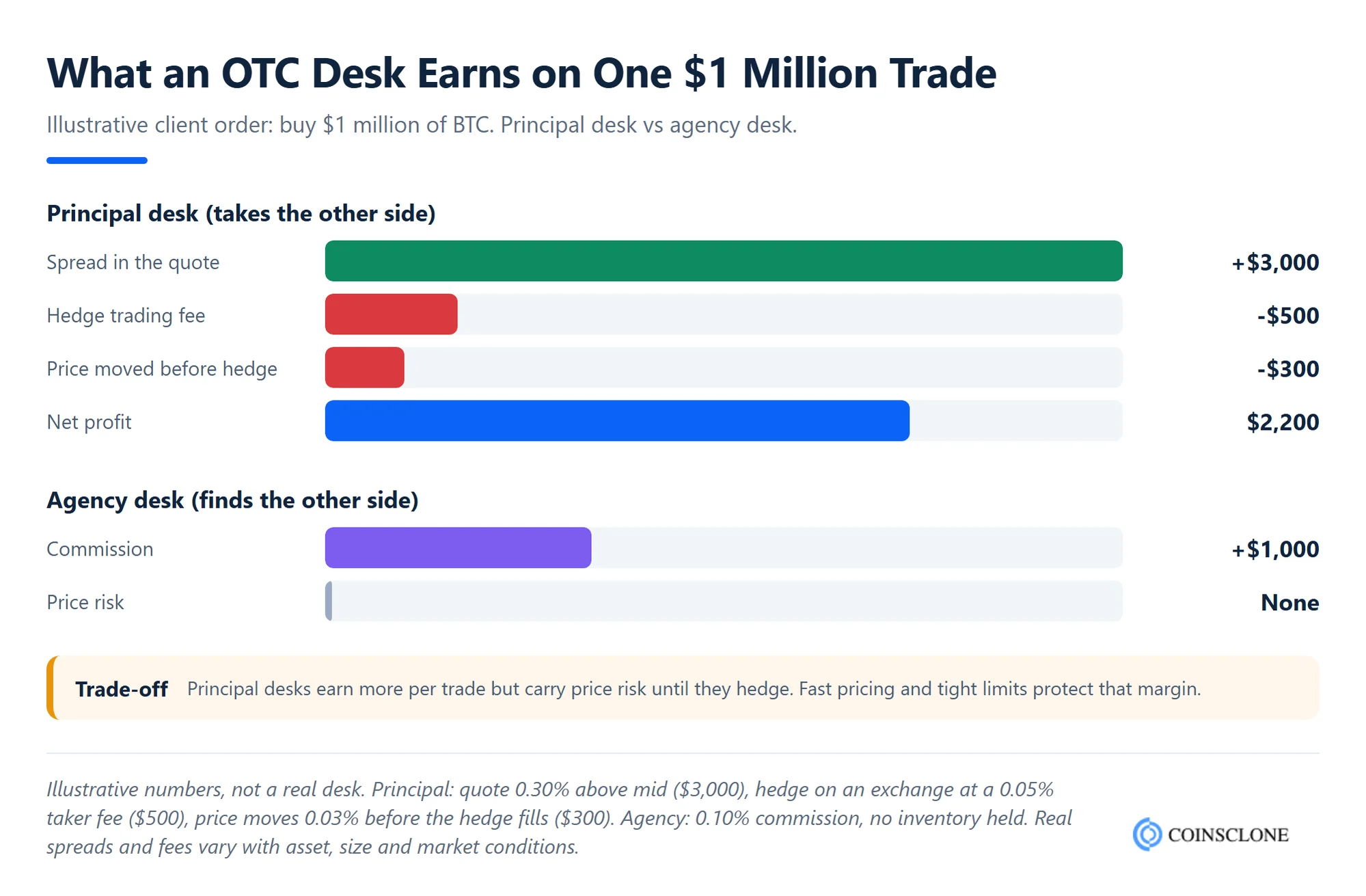
- How desks earn money, with a worked example on a $1 million trade
- The 2026 licence rules, launch timelines and what drives the cost
Launch Your OTC Exchange the Smart Way – Faster!
OTC Crypto Exchange Script — built for speed, scale, and trust.
- Lightning-Fast MVP : Go from concept to live OTC platform 90% faster.
- Liquidity & Wallets : Plug-and-play modules — zero coding
- Full Branding & Customization : Your logo, your UI, your token pairs
- Revenue-Ready : Earn from spreads, transaction fees, and premium services
Get a free branded demo of your OTC exchange in just 48 hours — before you spend a cent.
Book a Free Demo to see how our OTC Crypto Exchange Script can take you from idea to launch in 8 – 12 weeks.
What Is an OTC Crypto Exchange Script?
An OTC crypto exchange script is ready-made, custom-ready software that lets a business launch its own over-the-counter crypto trading desk. Clients ask for a price, get a firm quote and trade large amounts in private, without touching a public order book. The script comes with KYC and AML checks, a request-for-quote (RFQ) engine, a pricing engine fed by liquidity partners, wallets, settlement tools and an admin panel. You add your brand, pick your coins and fiat rails, and go live much faster than with a build from scratch.
In short, the script gives you the tech of a desk like Kraken OTC or Coinbase Prime. You bring the clients, the liquidity partners and the licence.
OTC Desk vs Order-Book Exchange
An OTC desk and a normal exchange both trade crypto, but they work in very different ways. Here is how they compare.
| Point | OTC desk | Order-book exchange |
| How price is set | The desk quotes one firm price for the full size | Many buy and sell orders meet on a public book |
| Price impact | None for the client; the quote is fixed | Large orders eat through the book and move the price |
| Privacy | Trade is private between client and desk | Every order shows on the public book |
| Typical size | Often $50,000 and up per trade | Any size, mostly small retail orders |
| Clients | Funds, brokers, miners, firms, wealthy traders | Mostly retail traders |
| Settlement | Pre-funded, on credit with netting, or escrow | Instant inside the exchange’s own ledger |
| How it earns | Spread in the quote or a commission | Maker and taker fees on each order |
For a real benchmark, Kraken lowered its OTC minimum to $50,000 in March 2025, with trades done over chat or through an automated RFQ. Your own desk can set any minimum that fits your clients.
Why OTC Crypto Trading Is Growing in 2026
OTC used to be a quiet corner of the market. That has changed. According to the Finery Markets 2025 OTC report, spot OTC volume grew 109% year on year in 2025. Over the same time, spot volume on the top 20 central exchanges grew only about 9%.
Stablecoins drive much of this growth. They made up 78% of OTC trades in 2025, up from 26% two years earlier. In other words, firms now use OTC desks to move between cash, USDT, USDC and major coins at size. Because of this, a new desk that handles stablecoin and fiat pairs well can serve payment firms, exchanges and treasuries, not just traders.
Salient Features of Our OTC Crypto Exchange Script
The OTC crypto exchange script comes with the features a desk needs on day one. We group them by who uses them.
Trading Features
- RFQ engine: Clients ask for a price on a pair and size, and get a firm quote with a short expiry, often a few seconds.
- Pricing engine: Pulls live prices from linked exchanges and liquidity providers, then adds your spread by client tier and trade size.
- Chat and voice deals: Desk traders can agree a price in chat and book it, for very large or rare trades.
- Fiat on and off ramps: Bank wires and payment rails for USD, EUR and local fiat, plus stablecoin pairs.
- Multi-crypto wallets: Hot, warm and cold wallets for each coin, with whitelisted client addresses.
- Real-time charts: Live prices and trade history so clients can time their requests.
- Algo orders: TWAP-style orders that split one big trade into smaller slices over time.
Compliance Features
- KYC and KYB checks: ID checks for people and company checks for firms, with source-of-funds review.
- AML and sanctions screening: Screens clients and wallet addresses before and after each trade.
- Travel Rule support: Sends and receives sender and receiver details for transfers to other exchanges.
- Audit trail: Every quote, trade and payment is time-stamped and stored for reports.
Admin Features
- Client and tier management: Set fees, spreads and limits for each client group.
- Credit and position limits: Pre-trade checks stop any client or trader from going over a set limit.
- Trader blotter: One live view of all open quotes, trades and positions.
- Settlement tracking: Shows what each client owes and is owed, and flags late payments.
- Reports and revenue view: Daily profit, volume by pair and client, and export for your accountant.
- White labelling: Your brand, your domain, your colours and languages.
You can add more modules later, such as staking, an OTC options desk or a client mobile app. Since every trade is large, though, security matters more than any add-on.
Security Features of OTC Cryptocurrency Exchange Script
The bug-free OTC cryptocurrency exchange script builds in these security features.
- HTTP authentication
- Jail login
- Data encryption
- Two-factor authentication
- Anti-fraud system
- SQL injection prevention
- Anti denial of service (DoS)
- Cross-site request forgery (CSRF) protection
- Server-side request forgery (SSRF) protection
- Anti-phishing tools
- Cold storage with multisig or MPC signing
- Address whitelisting and device checks
Overall, the OTC crypto exchange script blends strong trading tools with layered security. As a result, it is a solid choice for startups and brokers that want to serve large clients safely from launch.
How Does Our OTC Crypto Exchange Script Work?
An OTC trade runs as a private deal between the client and your desk. There is no public order book and no third party in the middle. Here is how a trade moves through the script.
- Sign up and checks: The client signs up with an email and phone number. Then they pass KYC, or KYB for a firm, along with sanctions and source-of-funds checks. For firms, this step can take several days.
- Account set-up: The admin approves the account, sets the client’s tier, spread and limits, and whitelists their bank account and wallet addresses.
- Funding or credit: The client pre-funds the account with fiat or crypto, or the desk grants a credit line to a trusted client.
- Request for quote: The client asks for a price, for example “buy 20 BTC with USD”. The pricing engine checks live liquidity and returns one firm, all-in quote.
- Accept and execute: The client accepts before the quote expires. The trade books at that exact price, and the desk hedges its side with liquidity partners if needed.
- Settlement: Funds and coins move. Pre-funded trades settle at once. Credit trades net out at the end of the day. Escrow trades release both sides together.
- Confirmation and records: The client gets a trade note, and the system stores the full audit trail for reports and tax.
The admin keeps full control of the platform. For extra safety, the admin dashboard has monitoring, alerts and audit tools.
Which Settlement Model Should Your Desk Use?
Settlement is the biggest design choice in an OTC desk. It decides your risk, the clients you can serve and how long the build takes. Use this tree to pick a starting point.
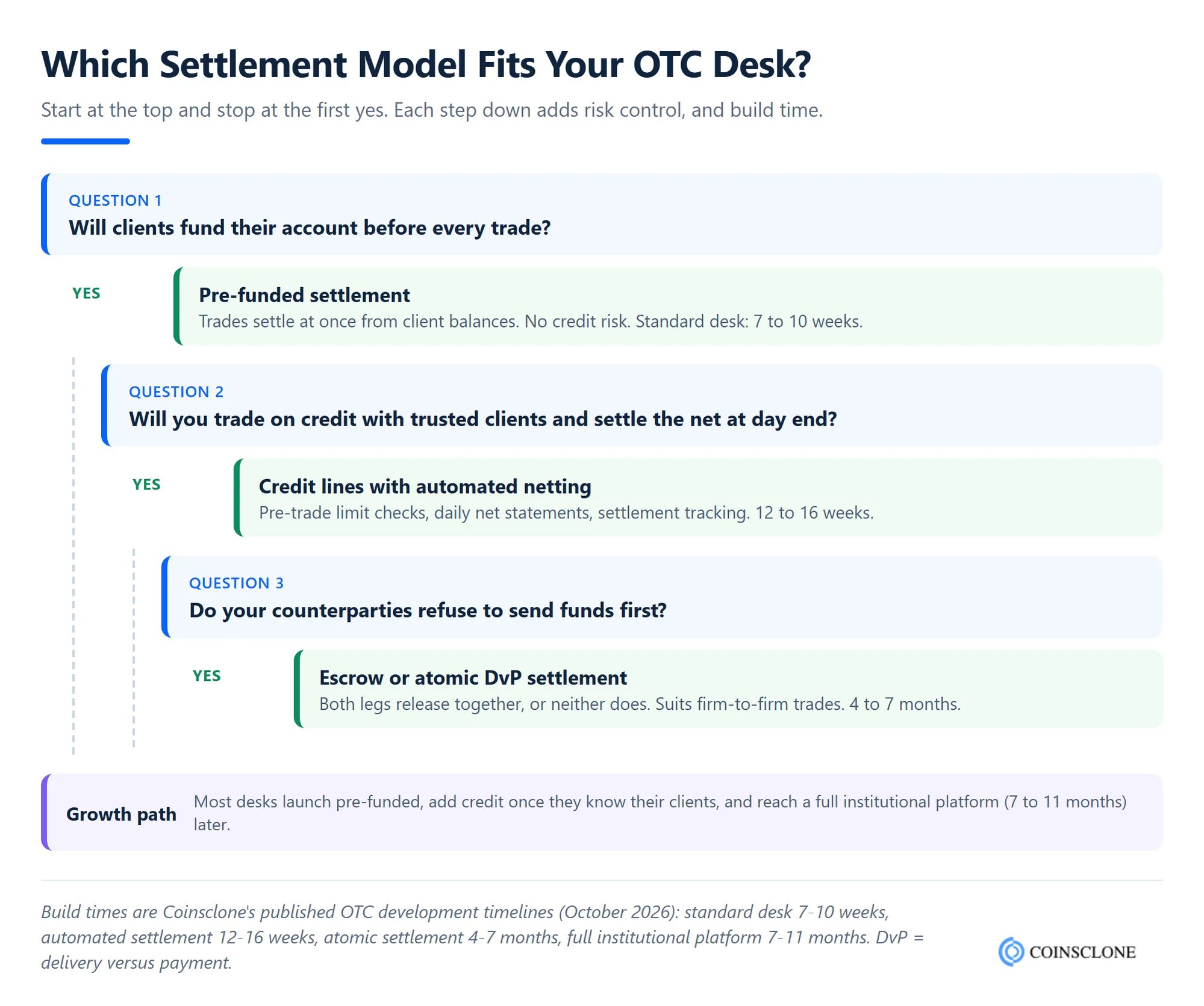
Most new desks start pre-funded, then add credit lines once they know their clients. Escrow or atomic settlement suits desks that trade with other firms who will not send funds first.
How an OTC Desk Makes Money: Principal vs Agency
There are two ways to run an OTC desk, and they earn money in different ways.
- Principal desk: Your desk takes the other side of the trade. You quote a price a little above or below the market mid-price and keep the gap as the spread. Then you hedge on exchanges or with liquidity partners. You earn more, but you carry price risk until the hedge is done.
- Agency desk: Your desk finds the other side for the client and charges a commission. You never hold the coins, so there is no price risk, but the margin is lower.
Many desks mix both. They act as principal on liquid pairs like BTC/USD and USDT/USD, and as agent on rare coins. Beyond trading, desks also earn from settlement fees, credit and financing charges, custody fees and referral deals. Here is an illustrative example of how the numbers can look on one trade.
Business Benefits of Using Our OTC Exchange Script
The OTC crypto exchange script helps you launch a secure desk fast and at a lower cost than a full custom build. It also gives you room to grow.
Time-Saving
The OTC crypto exchange software cuts build time sharply, because the core is already built and tested. A standard OTC desk on our script takes 7 to 10 weeks. A desk with automated settlement takes 12 to 16 weeks. So you can win early clients while others are still building.
Cost-Effective
A script costs far less up front than a custom platform, since you only pay to adapt a working product. It is an ideal choice for startups and brokers. After launch, support and updates also cost less, because the base code is shared and well known.
Customization
You can extend the OTC exchange script with add-on features, themes and designs. As the business grows, you can add new pairs, fiat rails, settlement models and security modules without a rebuild.
Reliability
The script follows proven flows used by leading OTC desks. It has been tested in real trading, so it is less prone to failures than new, untested code.
Enhanced Security
Security is key in crypto, and even more so at OTC trade sizes. The script protects funds and data with encryption, cold storage, multisig or MPC signing and strict access rules.
Exchange Clone Scripts With an OTC Desk Module
Many firms want an OTC desk inside a full exchange, like the big platforms run. We offer clone scripts of top exchanges that ship with an OTC or block-trade module:
- Coinbase Prime clone script
- Kraken clone script
- Crypto.com clone script
- Binance clone script
- WazirX clone script
- Bitfinex clone script
- OKX clone script
- HTX (formerly Huobi) clone script
Each script copies the core flows of these exchanges while letting you change anything to fit your business. If you want a branded exchange with OTC built in from day one, our white label crypto exchange software is the fastest route.
Licences and Rules for an OTC Crypto Desk in 2026
The script handles the tech, but you also need the right licence where you serve clients. The rules tightened a lot this year.
- European Union: Under MiCA, swapping crypto for cash or other crypto is a licensed service. The transition period ended on 1 July 2026, so firms with no MiCA licence must stop serving EU clients. A desk that swaps crypto for funds needs at least EUR 125,000 in capital.
- United States: An OTC desk is usually a money services business. It must register with FinCEN, run an AML program, apply the Travel Rule from $3,000, and hold state licences where needed.
- UAE and others: Dubai, Singapore, Hong Kong and the UK each have their own crypto licence or registration rules for broker or dealer work. Check local rules before you onboard clients there.
Our script includes the KYC, screening, Travel Rule and audit tools these rules ask for. Even so, plan your licence early, because it often takes longer than the build.
What Is the Actual Cost of an OTC Exchange Script?
The cost of an OTC exchange script depends on your scope. A script with pre-funded settlement and a few pairs costs much less than a full institutional platform with credit lines, escrow and many liquidity links. These are the main cost drivers:
- Settlement model: Pre-funded is simplest. Credit netting and escrow or atomic settlement add weeks and cost.
- Liquidity links: Each exchange or liquidity partner API takes work to connect and test.
- Fiat rails: Bank and payment links vary by country and partner.
- Compliance stack: KYC, KYB, wallet screening and Travel Rule tools carry setup and per-check fees.
- Custom features: Algo orders, client apps, options desks and extra reports raise the price.
- Hosting and security audits: Servers, monitoring and outside audits are ongoing costs.
Don’t forget costs beyond software. Licences, capital rules such as MiCA’s EUR 125,000 minimum, legal fees and desk staff can cost more than the script itself. For a full breakdown by method, see our guide on the cost to build an OTC exchange. For an exact quote, share your scope with our team.
Why Choose Coinsclone’s OTC Crypto Exchange Script?
Coinsclone is a well-known Web3 clone script development company. Since 2018, we have delivered 350+ platforms for 200+ clients across 20 industries, from exchanges and wallets to payment gateways and tokens. Our OTC crypto exchange script stands out for its RFQ and pricing engine, strong security and fast, stable performance.
Our OTC exchange script is fully designed, built, tested and ready to deploy. You can add the changes you need and launch your own OTC desk with help from our experts. Besides that, our support team is on hand 24/7. If you need a desk shaped around your clients and settlement flows, our OTC crypto exchange development team builds it from scoping to launch.
So, what are you waiting for? Talk to our experts and get a free demo of our OTC crypto exchange script today.
Frequently Asked Questions
What is an OTC crypto exchange?
An OTC crypto exchange, or OTC desk, is a service where clients trade large amounts of crypto directly with a desk instead of on a public order book. The desk gives one firm price for the full size, so the trade does not move the market, and the deal stays private.
How does an OTC crypto trading platform work?
The client passes KYC, funds the account or gets a credit line, then asks for a quote. The desk returns a firm price that is valid for a few seconds. If the client accepts, the trade books at that price and settles as pre-funded, net at day end, or through escrow.
What is the minimum trade size on an OTC desk?
It depends on the desk. Kraken’s OTC desk, for example, has a $50,000 minimum. When you run your own desk with our script, you set the minimum per client tier.
How do OTC desks make money?
Principal desks earn the spread built into their quotes, then hedge their risk. Agency desks charge a commission for finding the other side. Many desks also earn settlement, financing, custody and referral fees.
Do you provide liquidity partners?
The script connects to exchanges and liquidity providers through APIs, and we help you link the partners you choose. Strong liquidity keeps your quotes tight, even on large trades.
Can I integrate fiat payment systems into the OTC exchange script?
Yes. The script supports bank wires and payment gateways for USD, EUR and local fiat, along with stablecoin pairs. Which rails you can use depends on your banking partners and licence.
How long does it take to launch an OTC crypto exchange?
On our script, a standard OTC desk takes 7 to 10 weeks. A desk with automated settlement takes 12 to 16 weeks, and one with atomic settlement takes 4 to 7 months. A full institutional platform takes 7 to 11 months.
Can I customize the OTC exchange script for regional rules?
Yes. You can set KYC levels, Travel Rule limits, client limits and reports for each region you serve, such as MiCA in the EU or FinCEN rules in the US.
Launch Your OTC Exchange the Smart Way – Faster!
OTC Crypto Exchange Script — built for speed, scale, and trust.
- Lightning-Fast MVP : Go from concept to live OTC platform 90% faster.
- Liquidity & Wallets : Plug-and-play modules — zero coding
- Full Branding & Customization : Your logo, your UI, your token pairs
- Revenue-Ready : Earn from spreads, transaction fees, and premium services
Get a free branded demo of your OTC exchange in just 48 hours — before you spend a cent.
Book a Free Demo to see how our OTC Crypto Exchange Script can take you from idea to launch in 8 – 12 weeks.