

Blockchain is no longer just about buying coins and hoping they go up. In 2026, people earn from blockchain by staking, lending, running infrastructure, building products and working in the industry. Businesses earn even more: Coinbase reported $1.2 billion in revenue in a single quarter of 2026, and Tether reported $13 billion in profit for 2024.
But many “make money with blockchain” guides promise easy returns that do not exist. In this guide, we cover 10 real ways to make money with blockchain technology, with the actual yields and figures for each, the risks that come with them, and how blockchain companies and startups earn their money.
10 Ways to Make Money With Blockchain Technology
Ways for individuals:
- Staking
- Lending stablecoins
- Providing liquidity
- Running a validator or node
- Crypto mining
- Investing in crypto and crypto funds
- Working as a blockchain developer
- Freelance content, design and community work
- Bug bounties and security research
Ways for businesses:
- Building a blockchain business
1. Staking
Staking means locking up coins to help secure a proof-of-stake blockchain, such as Ethereum or Solana. In return, you earn rewards. You can stake directly, through an exchange, or through a liquid staking service such as Lido, which gives you a token you can still use.
What it pays: On 27 September 2026, staking ETH through Lido paid about 2.2% a year, and staking SOL through Jito paid about 4.9%.
Risks: The coin’s price can fall far more than the reward. Liquid staking adds smart contract risk. Learn more about how a staking platform works.
2. Lending Stablecoins
You can lend stablecoins such as USDC and USDT on DeFi protocols like Aave and earn interest from borrowers. Because stablecoins stay near $1, you avoid most price risk.
What it pays: About 3.6% on USDC and 4.2% on USDT on Aave (Ethereum), and about 3.6% in Sky’s sUSDS savings, in September 2026.
Risks: Smart contract bugs, a stablecoin losing its peg, and rates that change daily. See the top DeFi lending platforms.
3. Providing Liquidity
You can add tokens to a liquidity pool on a decentralized exchange and earn a share of the trading fees.
What it pays: Stablecoin pools pay about 0% to 5%. Busy pairs such as ETH-USDC on Uniswap (Base) paid about 24% a year in fees in September 2026.
Risks: Impermanent loss when prices move, which can wipe out fee income. Our guide to the best DeFi liquidity pools explains it with real numbers.
4. Running a Validator or Node
Validators run the software that confirms transactions and earn rewards for it. Running your own Ethereum validator needs 32 ETH, reliable hardware and good uptime. Many networks also pay node operators for services such as data, storage or oracles.
What it pays: Similar to staking rewards, plus any tips or fees, but you keep the full reward rather than paying a provider.
Risks: Penalties for downtime or mistakes, and technical work to keep the node secure and updated.
5. Crypto Mining
Proof-of-work blockchains like Bitcoin pay miners to add new blocks. Since the April 2024 halving, each new Bitcoin block pays 3.125 BTC, plus transaction fees. About 144 blocks are mined each day.
What it pays: Across the whole network, miners earn roughly $13.9 billion a year at a bitcoin price of about $84,000. But that is shared among huge industrial operations.
Risks: Mining needs specialised ASIC machines and very cheap electricity. For most individuals at home, the power bill costs more than the bitcoin earned. Mining pools and hosted mining exist, but check every contract carefully, because “cloud mining” is a common scam.
6. Investing in Crypto and Crypto Funds
You can buy coins directly, or invest through regulated funds. US spot bitcoin ETFs launched in January 2024 and spot ether ETFs in July 2024, letting people invest through normal brokerage accounts.
What it pays: Returns depend entirely on price, which can rise or fall sharply. Bitcoin traded near $84,000 in September 2026.
Risks: High volatility. Only invest what you can afford to lose, and use trusted, regulated platforms.
7. Working as a Blockchain Developer
Smart contract, protocol and security developers are among the best-paid people in tech. Skills in Solidity, Rust, security auditing and zero-knowledge proofs are in especially high demand.
What it pays: Salaries for experienced smart contract and security developers are often well above general software roles, and many jobs are remote.
How to start: Learn Solidity or Rust, build and publish small projects, and contribute to open-source code. See our guide on how to build a blockchain application.
8. Freelance Content, Design and Community Work
Blockchain projects need writers who can explain technical ideas clearly, designers, video creators, translators and community managers. Many hire freelancers and pay per project.
What it pays: Rates vary with skill and project. Clear technical writing and strong community management are the most valued.
Tip: Build a portfolio with real examples, and be wary of projects that want to pay only in their own new token.
9. Bug Bounties and Security Research
DeFi protocols pay large rewards to people who find and report security bugs before attackers do. Platforms such as Immunefi list bounties from many projects.
What it pays: Critical bug bounties can reach hundreds of thousands, or even millions, of dollars.
Skills needed: Deep knowledge of smart contracts and common attack patterns.
10. Building a Blockchain Business
This is where most of the money in blockchain is made. Businesses earn from:
- Crypto exchanges: Trading fees, listings, staking and more. See how crypto exchanges make money.
- Crypto wallets: Swap fees, staking and on-ramp referrals. See how crypto wallets make money.
- Payment gateways: A small fee on every merchant payment.
- Stablecoins: Interest earned on the reserves behind each coin.
- Tokenization platforms: Fees for turning real-world assets into tokens. See real world asset tokenization.
- Blockchain services: Development, consulting, auditing and infrastructure for other companies.
What Blockchain Income Actually Pays
Here is how the passive options compare, side by side:
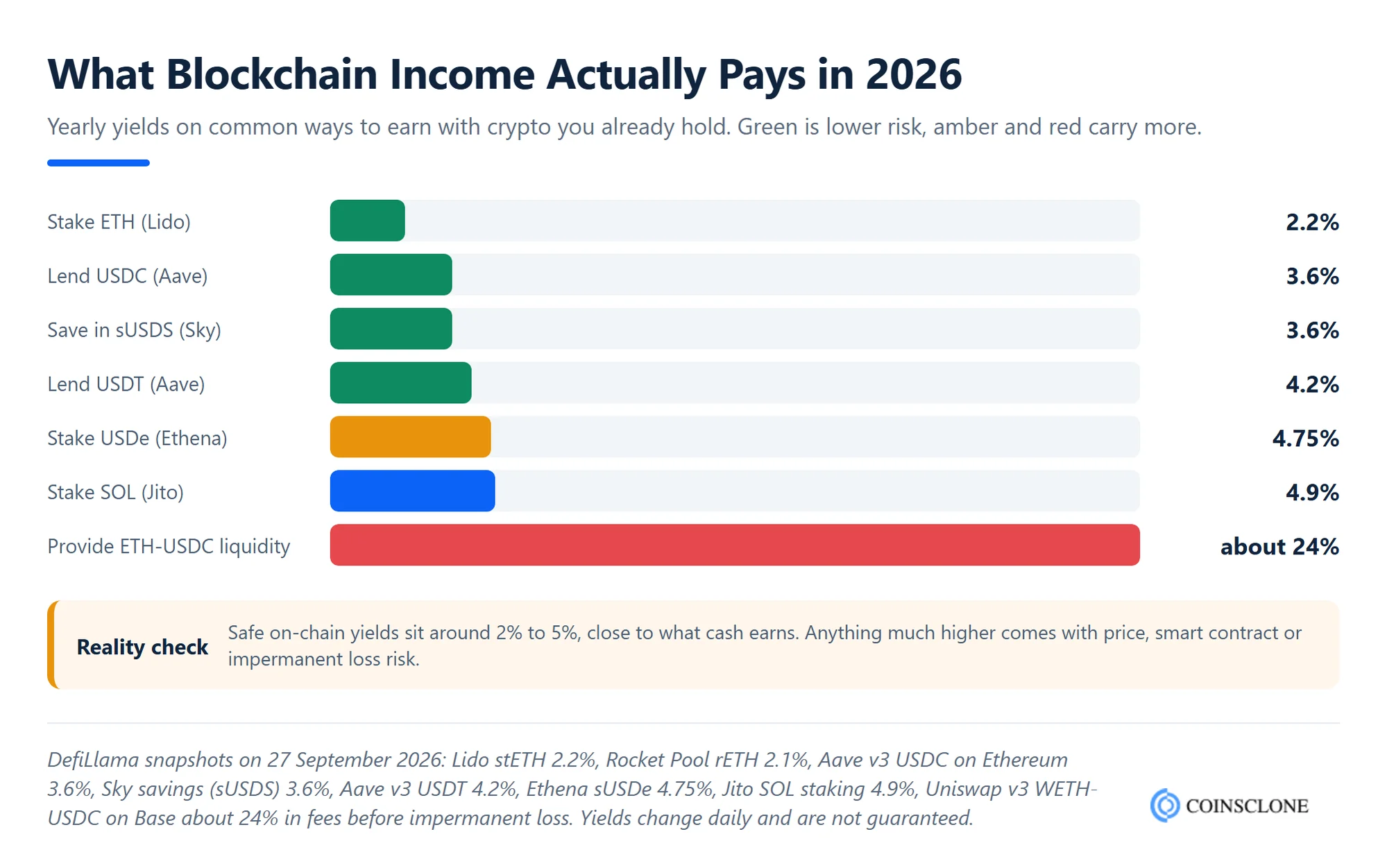
The pattern is clear. The safest on-chain yields sit around 2% to 5%. Higher numbers exist, but they come with more risk. Treat any promise of fixed, high daily returns as a warning sign.
How Do Blockchains Make Money?
A blockchain network itself earns from the fees users pay to send transactions. Those fees, plus any new coins, go to the validators or miners who secure the network.
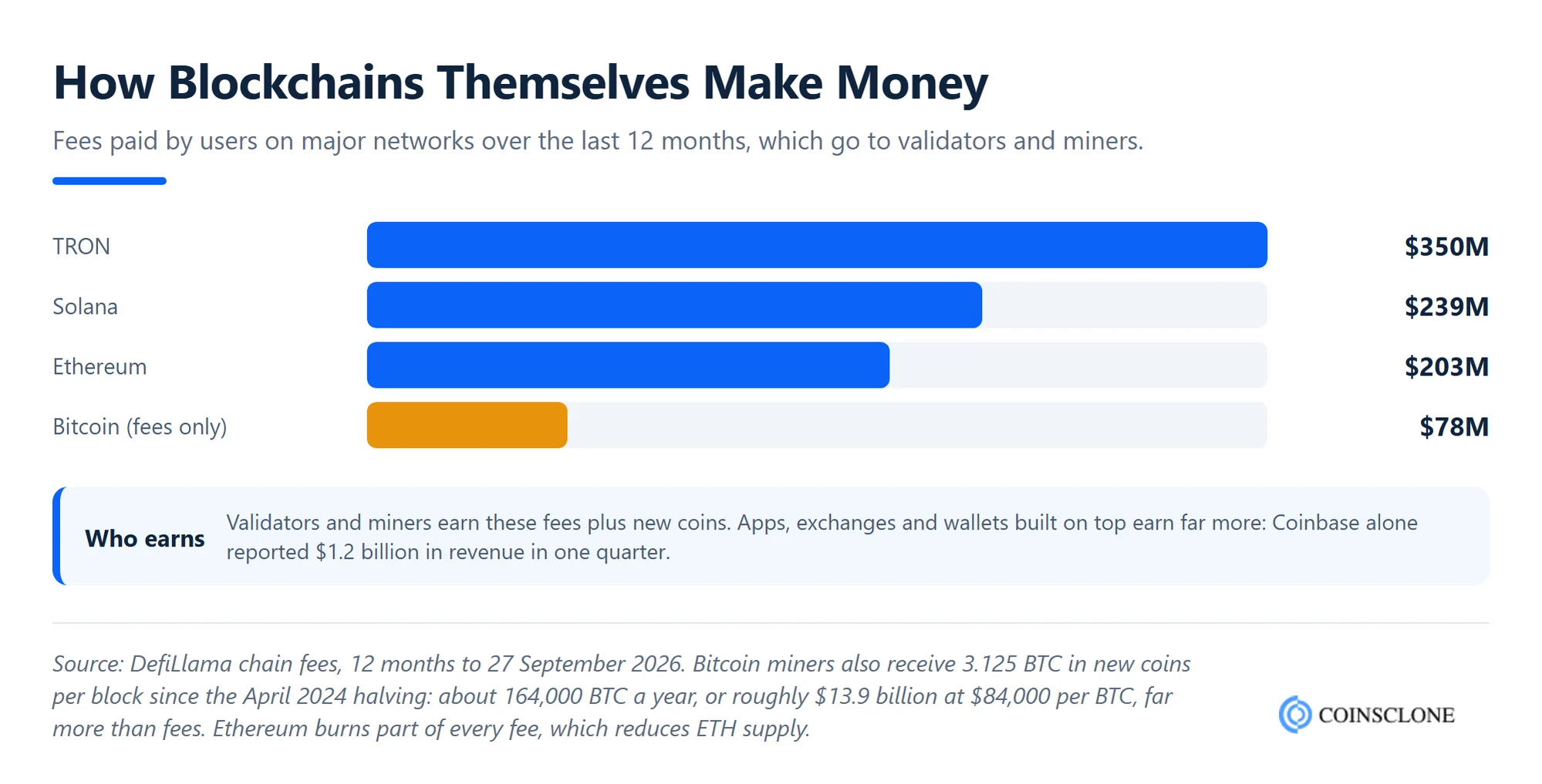
TRON earns the most in fees, mainly because of heavy USDT use. On Bitcoin, fees are small compared with the new coins miners receive. On Ethereum, part of every fee is burned, which reduces the supply of ETH.
How Do Blockchain Companies and Startups Make Money?
The companies built on top of blockchains usually earn far more than the networks:
- Coinbase earned about $1.2 billion in revenue in Q2 2026. About half came from trading fees and the rest from stablecoin interest, staking and subscriptions.
- Tether reported about $13 billion in profit for 2024, mostly from interest on the US Treasury bills backing USDT.
- DeFi protocols earn a share of trading, lending or staking fees. Hyperliquid kept about $688 million of fees over the 12 months to September 2026.
Most blockchain startups combine a few models: transaction fees, subscriptions, token-based incentives and services to other businesses.
Are Blockchain Projects Profitable?
Some are very profitable, but many are not. The ones that make money have real users and a clear reason to pay, such as trading, payments or savings. Many token projects never earn real revenue and rely on selling tokens, which rarely lasts.
Before investing time or money in any project, ask three questions:
- Who pays, and why? Real revenue comes from users paying for a service.
- Is the revenue real? Check public data on sites such as DefiLlama.
- What happens if the token price falls? A business that only works when its token rises is fragile.
Blockchain Use Cases That Make Money for Businesses
Payments and Stablecoins
Stablecoins let businesses send and receive money across borders in minutes, often at lower cost than banks. Payment companies and fintechs are adding stablecoin rails to their products.
Tokenization of Real-World Assets
Assets such as treasury funds, real estate, gold and private credit can be turned into tokens, allowing fractional ownership and faster settlement. A business can earn from issuance, management and trading fees. Security tokens can also help raise capital through a security token offering.
Real Estate
Blockchain can record property ownership, automate escrow with smart contracts, and let investors buy fractions of a property. Smaller investors get access, and owners get a new way to raise funds.
Healthcare
Blockchain can give patients control of their records, share data securely with doctors and insurers, and track medicines through the supply chain to reduce fakes.
Supply Chain
Recording each step of a product’s journey on a blockchain makes it easier to prove origin and stop counterfeits.
Risks and Scams to Avoid
- Guaranteed returns: No real blockchain investment can promise fixed high returns.
- Cloud mining and “bitcoin robot” schemes: Many take deposits and show fake profits.
- Fake tokens and airdrops: Always verify contract addresses and never share your recovery phrase.
- Unaudited DeFi apps: New protocols with very high yields are often the ones that get hacked.
- Tax and legal rules: Crypto income is taxed in most countries. Keep records.
Start a Blockchain Business With Coinsclone
If you want to earn from blockchain as a business, the proven paths are exchanges, wallets, payment gateways and tokenization platforms. Coinsclone has delivered more than 350 blockchain platforms for over 200 clients across these models. Our team can help you choose a model, plan the revenue and launch it securely. Talk to our team for a free consultation.
Related Articles
How Much Does Blockchain App Development Cost?
Frequently Asked Questions
How can I make money with blockchain technology?
Individuals can earn by staking, lending stablecoins, providing liquidity, running validators, investing, working as a developer or freelancer, or finding security bugs. Businesses earn by building exchanges, wallets, payment gateways and tokenization platforms.
How does blockchain make money?
Blockchain networks earn transaction fees, which go to the validators or miners who secure them, along with new coins on some networks. Companies built on blockchains earn from trading fees, interest, subscriptions and services.
How do blockchain startups make money?
Most combine transaction fees, subscription plans, services to other businesses and, sometimes, token-based incentives. The strongest have real users paying for a real service.
Is crypto mining still profitable?
For large operations with very cheap electricity and the latest machines, yes. For most people mining at home, electricity costs are higher than the bitcoin earned.
What is the safest way to earn with blockchain?
Lending major stablecoins on established protocols or staking ETH through established providers are among the lower-risk options, paying about 2% to 5% in 2026. They still carry smart contract and platform risk.
Can I make money with blockchain without investing?
Yes. You can work as a developer, freelancer, community manager or security researcher and be paid for your skills.
Are blockchain projects profitable?
Some are highly profitable, especially exchanges, stablecoin issuers and popular DeFi protocols. Many token projects are not, because they lack real revenue.
How do smart contracts make money?
Smart contracts do not earn by themselves. The apps that use them charge fees, such as swap fees on a DEX or interest on a lending protocol, and the smart contract collects those fees automatically.