
What Is an STO?
A security token offering issues a token that legally represents a security: equity, debt, a fund unit or a revenue share. It is a regulated instrument, so who may hold it, who they may transfer it to, and what they must be told are set by law rather than by you.
Which makes this compliance engineering before it is token engineering. Your counsel determines the exemption, the investor tests and the holding periods; our job is to make the contract enforce exactly that, permanently and verifiably.
What You Receive
| Component | What It Covers |
|---|---|
| Security token contract | Permissioned transfer with restriction rules enforced on chain |
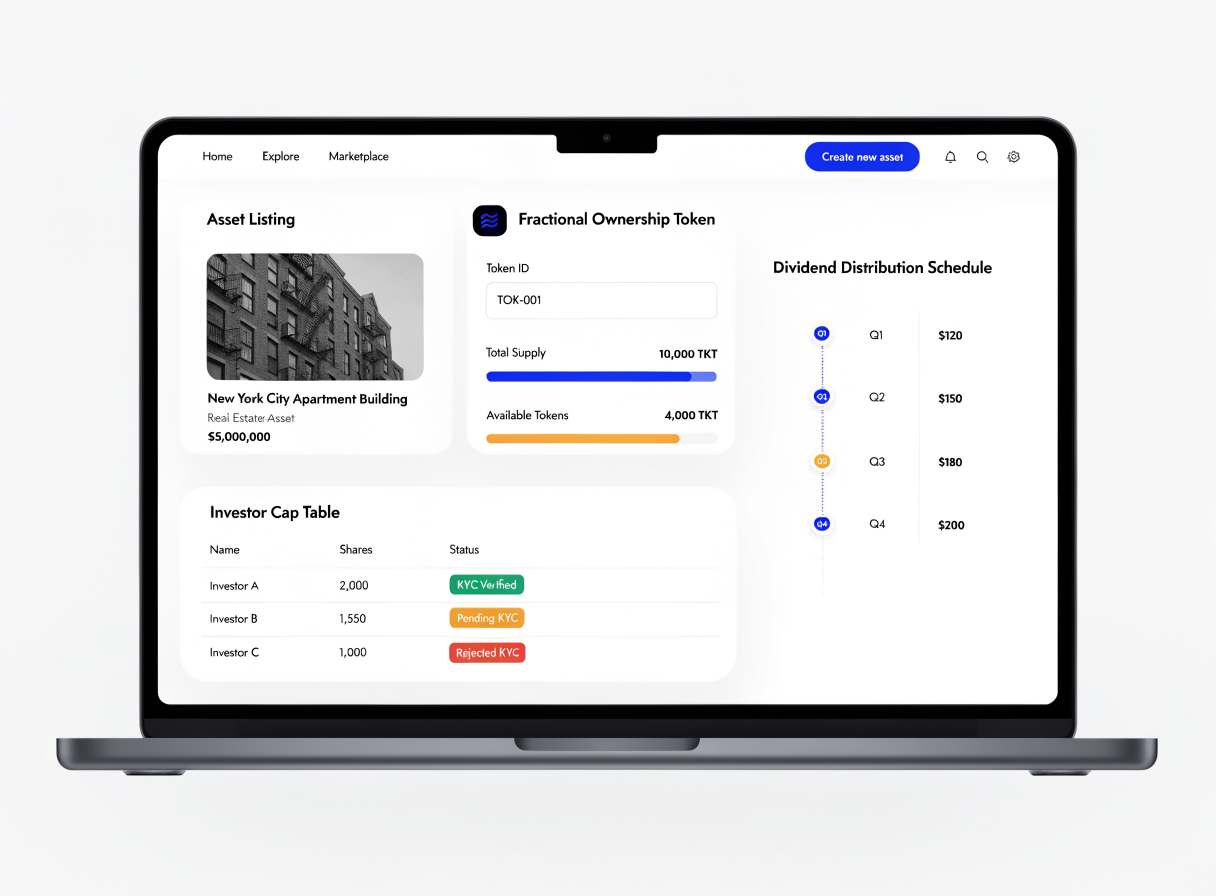
| Investor register | Cap table maintained on chain with off-chain identity linkage |
| Accreditation system | Verification of investor eligibility before any allocation |
| Transfer controls | Holding periods, jurisdiction rules and counterparty checks |
| Distribution handling | Dividend, interest or revenue share payments to holders |
| Reporting | Regulator and investor reporting with exportable statements |
| Independent audit | Third-party review of transfer and distribution paths |
| Source code | Contracts, platform and documentation on delivery |
Share your instrument and jurisdictions and we will map the enforcement requirements before building.
Get a Free Live DemoA Restriction in a Document Is Not a Restriction
If your offering document says a token cannot be transferred to a non-accredited investor, and the contract allows any transfer, then the restriction does not exist. The chain will execute whatever the code permits.
That is the central engineering requirement of an STO. Every rule your counsel identifies — accreditation, jurisdiction, holding period, transfer approval, maximum holders — has to be a check the contract performs before it moves anything.
Restrictions enforced in code not described in a PDF nobody can execute.
Accreditation checked pre-transfer on both sides, before the transfer succeeds.
Jurisdiction rules on chain so a blocked country is blocked, not requested to abstain.
Holding periods automatic lockups that release by date rather than by honour.
Cap table always current because a register that lags is a compliance failure.
Forced transfer capability where law requires it, scoped and logged.
We will not build an STO that says one thing in its documentation and permits another in its contract. That gap is the single most common failure in tokenized securities.
Surfaces This Scope Covers
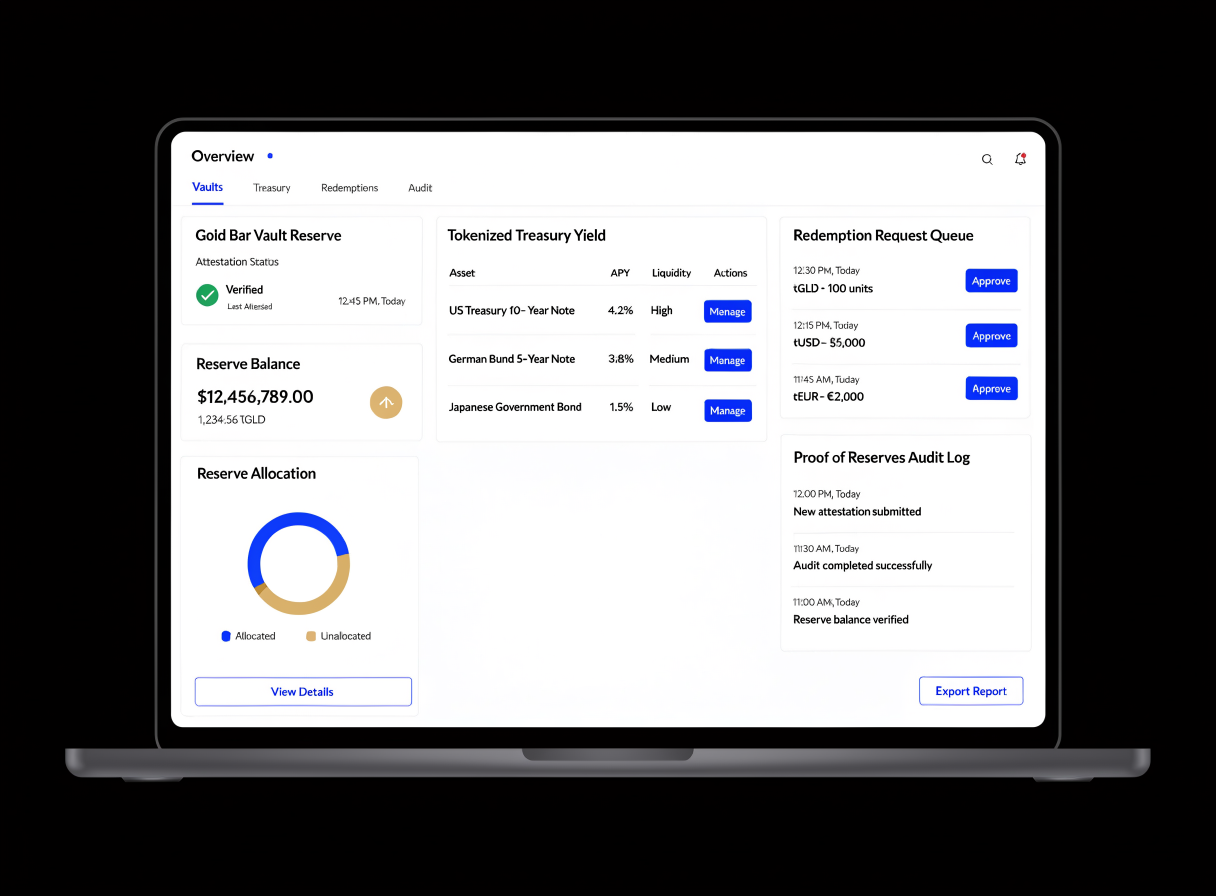
Reference concepts for an on-chain build — swap, liquidity and position surfaces. Not screenshots of a delivered client protocol; audited deployments are shown on a call.
Core Features
Token and Restrictions
- ERC1400 or ERC3643 permissioned transfer standards
- Whitelist-based transfer with pre-trade validation
- Jurisdiction and residency restriction enforcement
- Holding period and lockup automation
- Maximum holder count enforcement
- Partition and tranche support for share classes
- Forced transfer and recovery where law requires
Investors and Onboarding
- Accreditation and suitability verification
- KYC, KYB and beneficial ownership checks
- Sanctions and PEP screening
- Subscription workflow with document execution
- Investor portal with holdings and statements
- Onboarding status tracking and audit trail
Cap Table and Distributions
- On-chain register reconciled with legal records
- Dividend, interest and revenue share distribution
- Payment in stablecoin or fiat via integration
- Withholding and tax data capture where required
- Corporate action handling for splits and conversions
- Distribution history per investor
Compliance and Reporting
- Regulator reporting with exportable formats
- Investor reporting on a defined cadence
- Transfer approval workflow where mandated
- Full audit trail of every restriction decision
- Independent audit of transfer and payment paths
- Document retention aligned to your obligations
Mapped to a release plan
We will send a compliance mapping, contract architecture and audit plan with a delivery timeline.
Request a Feature PlanHow a Security Token Offering Is Put Together
The modules above map onto these layers. Each one ships with its own tests, documentation and runbook, so nothing arrives as a black box you inherit without an explanation.
Requests flow down, settlement and events flow back up. Every boundary carries logging, so a failure is traceable to a layer instead of guessed at.
Chains and Standards We Deploy To
Each deployment is a separate audit surface, not a redeploy. Gas economics, MEV exposure and bridge assumptions differ per chain, and a contract that is safe on one can be attackable on another.
How We Build Your STO
Contracts and interface follow separate tracks with separate release gates, because one is permanent and the other is not.
Legal and structure scoping
Instrument type, exemption route, investor tests and holding periods, with your counsel.
Output → compliance matrix and enforcement specification
Contract and restriction design
Which rules the contract enforces and how each check is performed.
Output → contract architecture with restriction logic
Development
Token, register, distribution and portal built with full test coverage.
Output → staging platform with contract test reports
Independent audit
Third-party review of transfer, restriction and distribution paths.
Output → audit report with findings resolved
Issuance and operations
Deployment, investor onboarding, distribution runbooks and reporting.
Output → live offering with register and reporting operational
Chains we deploy to
Development Timeline
| Scope | Timeline | Includes |
|---|---|---|
| Standard STO | 8 to 12 weeks | Token, restrictions, register, portal, audit |
| STO with distributions | 13 to 18 weeks | Dividend handling, withholding data, reporting |
| Multi-jurisdiction STO | 5 to 8 months | Several exemption routes, per-region rules, extended compliance |
| Full issuance platform | 8 to 14 months | Multiple offerings, secondary transfer, institutional reporting |
What extends the timeline: legal structuring with your counsel, which gates all contract work; independent audit of restriction and distribution paths; accreditation and screening provider integration; and reconciliation between the on-chain register and your legal records, which needs care rather than speed.
Revenue Models
| Model | How It Works |
|---|---|
| Capital raised | The primary purpose of the offering |
| Reduced issuance cost | Automation replacing manual register and distribution work |
| Secondary transfer fees | Charges on compliant transfers where permitted |
| Distribution efficiency | Lower cost per payment across many holders |
| Broader investor access | Reaching investors a traditional process could not serve |
| Reporting automation | Reduced cost of regulator and investor reporting |
| Platform licensing | Revenue if you issue for third parties |
Every fee is public and comparable on-chain, so pricing has a hard competitive ceiling. We build fee parameters as governable values rather than constants so they can be tuned without redeployment.
Related services
Who This Is For
Tokenizing property equity or debt with investor restrictions.
Issuing tokenized fund units with automated register and NAV.
Raising equity or debt from eligible investors efficiently.
Issuing instruments tied to defined income streams.
Offering issuance as a service to their own clients.
Automating register, distribution and reporting at scale.
Why Choose Coinsclone
Legal structure leads
No contract work begins before your counsel has defined the exemption and investor tests.
Restrictions enforced in code
Every rule becomes a pre-transfer check rather than a paragraph in a PDF.
Register always current
On-chain cap table reconciled with legal records rather than lagging behind.
Distributions automated
Dividends and interest paid programmatically with withholding data captured.
Independently audited
Transfer, restriction and distribution paths reviewed before issuance.
Honest about liquidity
Permissioned tokens trade only among eligible holders, and we say so upfront.
What Our Clients Say
Operators who launched with us, in their own words. Hover to pause.














A members-only NFT marketplace for Digital Freemasonry
 Digital Free MasonryNFT marketplace · delivered and live
Next phase in progress: the ODFT Token and the MasonicVerse platform.
Working with Coinsclone has been one of the best professional experiences I have had in the blockchain industry.
From the very beginning of our NFT Marketplace project until its successful completion, the entire team demonstrated exceptional technical expertise, professionalism, patience, and commitment. Every stage of development was handled with great attention to detail, and every challenge we encountered was approached with a solution-oriented mindset.
Read the full client note
Our project was far from a standard NFT Marketplace. It included custom blockchain architecture, Polygon integration, ERC-721 and ERC-1155 standards, royalty implementation, token-gated access through Masonic Passport, multiple payment methods, marketplace customization, advanced testing, and many unique business requirements. Throughout the entire process, the team consistently delivered high-quality work while maintaining clear communication, transparency, and a strong commitment to excellence.
I would especially like to express my sincere appreciation to Mr. Jeeva, Mr. Bala, Mr. Saravanan, Mr. Veeramani, Mr. Akshay, and the entire development team for their outstanding support, professionalism, responsiveness, and dedication throughout the project. Their technical expertise, patience, and willingness to understand even the most complex business requirements gave us complete confidence during every phase of development.
What impressed me the most was not only their excellent blockchain development skills, but also their ability to understand our vision and transform it into a secure, scalable, and highly professional NFT Marketplace.
For me, Coinsclone is not simply a software development company — they are a trusted long-term technology partner. After successfully completing our NFT Marketplace, we are now preparing to continue our collaboration on the next major phase of the Digital Freemasonry ecosystem, including the development of the ODFT Token and the future MasonicVerse platform.
I highly recommend Coinsclone to anyone looking for a reliable, experienced, and highly professional blockchain development company. They have earned my complete trust and respect, and I sincerely look forward to working with them again on future projects.
Start Your STO Project
Tell us your target chains and the pairs you need to win and we will respond with a routing architecture and delivery timeline.
- Compliance requirements mapped into contract-level checks
- Independent audit of transfer and distribution paths
- NDA signed before technical discussion
Request received
A solution architect will reply within one business day with a scoped proposal and demo link.
STO Development: Frequently Asked Questions
What is an STO?
A security token offering: a token that legally represents a security such as equity, debt, a fund unit or a revenue share, subject to the securities law of the jurisdictions involved.
How is an STO different from an ICO?
An STO is explicitly a regulated security with defined investor eligibility, transfer restrictions and disclosure duties. An ICO is typically positioned as a utility token, which is a different legal analysis.
Do you provide the legal structuring?
No. Your counsel determines the instrument, exemption route and investor tests. We translate their requirements into contract-level enforcement and will not begin before they have advised.
Why must restrictions be in the contract?
Because a restriction the code does not enforce does not exist. If documentation says transfers are limited and the contract allows any transfer, the chain will execute whatever the code permits.
Which token standards suit security tokens?
ERC1400 and ERC3643 are designed for permissioned transfer with restriction hooks. A plain ERC20 cannot enforce eligibility, which makes it unsuitable for a regulated instrument.
How is investor accreditation handled?
Verified before any allocation and re-checked before each transfer, on both sides, so an eligible holder cannot transfer to an ineligible one even accidentally.
Can holding periods be enforced automatically?
Yes. Lockups release by date in the contract rather than relying on investors to honour them, which is what makes the restriction real.
How are dividends or interest paid?
Programmatically to the register, in stablecoin or via fiat integration, with withholding data captured where your obligations require it.
Does tokenizing a security make it liquid?
Less than is usually claimed. A permissioned token can only trade among eligible verified holders, so liquidity depends on the size of that pool rather than on the token format.
What is the real commercial benefit?
Usually operational: automating a register, distributions and reporting that were manual and expensive, and reaching eligible investors a traditional process could not serve efficiently.
How long does an STO take to build?
A standard STO takes 8 to 12 weeks. Adding distributions takes 13 to 18 weeks. Multi-jurisdiction offerings take 5 to 8 months, and a full issuance platform 8 to 14 months.
Will we own the contracts?
Yes. Token, register, distribution contracts, portal and documentation transfer on delivery, deployed under your own keys and governance.
Estimate Your Build
Pick a scope and the extras you need. On a protocol build the audit and economic-modelling lines are the ones that move the timeline, and neither compresses safely.
{{ estSummary }}
Ranges assume decisions arrive on time. Licensing, banking and third-party audits run on their own schedules and we plan around them rather than inside them.
Get This Scoped ProperlyReady to Issue a Security Token?
Share your instrument and jurisdictions and receive a compliance mapping, contract architecture, audit plan and delivery timeline.