Building a crypto token today has become an easier task, but will every crypto token launch bring success for startups? That’s where the real game begins, because behind every high-performing token lies a powerful blockchain platform that silently handles the speed, security, scalability, and seamless transactions.
The blockchain networks act as the launchpads of the crypto journey to create full-fledged crypto tokens for various industrial use cases. But multiple blockchains are launching every single day with multiple features. In the crypto market full of blockchain networks, making the right choice may feel like finding a needle in a haystack.
To ease your concerns, we have come up with this blog that lists the top 10 blockchain networks to create crypto tokens that stand out. Before finding the right blockchain network, know about the crypto token development process…
See How Our MVP System Can Power Your Blockchain Project Faster
Best Blockchain Platforms — built for speed, security & scalability.
- MVP System:Launch your blockchain network or dApp 90% faster.
- Modular Architecture:Plug-and-play smart contracts, wallets & APIs.
- Customization:Your consensus, your governance, your ecosystem.
- Revenue Engine:Monetize through staking, token sales, and transaction fees.
Get a free branded demo of your blockchain platform in just 48 hours — before you invest a cent.
Book a Free Demo to see how our Blockchain Development Framework takes you from concept to launch in 2–4 weeks.
What is Crypto Token Development?
Crypto token development is a process of creating digital assets that are primarily utilized for trading, staking, and lending purposes. Apart from that, they are widely utilized for crypto crowdfunding, RWA tokenization, and DAO governance. As these crypto tokens offer various benefits, the need to create a potential token has emerged.
Due to the decentralization, the need for security comes before other factors. The blockchains are highly preferred depending on their security, immutability, and efficient nature. Among the huge pool of feature-rich blockchains, startups are expected to pick the right one. The next section is all about the top 10 blockchain platforms to create crypto tokens efficiently.
Types & Token Standards For Crypto Token Creation
As blockchain technology continues to reshape sectors worldwide, understanding various token standards will ensure you stay at the forefront of the crypto world. Here is the list of various types of crypto tokens that can be created,
Fungible Token Creation
Fungible token creation is mainly based on blockchain technology, which ensures transparency, security, and decentralization. These tokens are homogeneous, divisible, and impersonal. These tokens are interchangeable and have identical value to be traded seamlessly. Fungible tokens are of two types: utility tokens and security tokens.
- Utility Token – Utility tokens are the most popular type of tokens created on blockchain platforms. These tokens provide access to the product or service offered by the startup. These tokens are widely utilized for crypto crowdfunding, rewards, the platform’s native tokens, etc.
- Security Token – Unlike utility tokens, security tokens represent ownership of a company or underlying asset. They are subject to securities regulations and may offer investors rights such as voting rights, profit sharing, or dividends. They act as a bridge between traditional financial markets and the emerging blockchain ecosystem.
Non-Fungible Token Creation
On the other hand, non-fungible tokens add a unique touch to the cryptocurrency world. Each NFT has a unique digital identity, so it cannot be replaced with another token. Think of NFTs as digital collectibles or virtual treasures that can be of immense value.
By utilizing various types of tokens, such as utility tokens, security tokens, and non-fungible tokens, startups can unlock new possibilities for growth and long-term success. To create a potential token for your business, pick the right blockchain network. The next section is all about the top-tier blockchain networks that are utilized to create a crypto token.
Top 10 Blockchain Platforms to Watch in 2026
Selecting the proper blockchain platform is a must as the Web3 landscape continues to move. Each platform has distinct and exceptional characteristics that can serve different purposes, ranging from DeFi and NFTs to global payments and enterprises. Let us take a look at the top 10 blockchain platforms that are most likely to rule in 2026.
- Ethereum
- Binance Smart Chain
- Tron
- Solana
- Polygon
- Avalanche
- Hyperledger
- Tezos
- Stellar
- XRP Ledger/Ripple
Ethereum (ETH)
Ethereum was introduced to the world in 2015 by the cryptographic master Vitalik Buterin and his team. Since then, it has continued to be the driving force behind primary events in decentralized finance, NFTs, and smart contract development.
Its remarkable market cap of almost $600 billion guarantees that it has the biggest developer community and ecosystem in the blockchain world. Its capacity to support all the various types of dApps, DeFi protocols, and NFT marketplaces is what makes it the favorite platform of large-scale Web3 innovation.
- ERC20 – The fungible token standard of the Ethereum blockchain remains as the crypto industry’s go-to framework for creating interchangeable tokens. They are known for their simplicity and efficiency, and they allow developers to create higher liquidity within the crypto platforms.
- ERC721 – The non-fungible token standard of the Ethereum blockchain enables users to convert unique pieces into tradable crypto tokens. The ERC721 standard has laid the foundation for gaining profits simply by converting collectibles, digital art, gaming items, etc., into tokens.
- ERC1155 – The ERC1155 token standard possesses both the fungible and non-fungible token characteristics within a single smart contract. With this ERC1155 token standard, developers can create dynamic tokens that can be utilized globally without any restrictions.
Binance Smart Chain (BNB Chain)
BNB Chain, which was launched by Binance in 2019, perfectly combines very low transaction costs and very fast confirmation, along with having full EVM compatibility. This blockchain is the most attractive platform for any cost-efficient DeFi startup, yield farming, and token launch. Since it is decentralized but very well connected to Binance’s global exchange ecosystem, it is a major player in price and performance for new companies.
- BEP20 – BNB Chain introduces BEP20 tokens that mirror the ERC20 token standard to offer a seamless transaction experience. The BEP20 tokens are highly compatible with the popular decentralized finance applications and ease the integration process within the growing BNB ecosystem.
- BEP721 – Similar to the ERC721 token standard, the BEP721 standard enables the creation of non-fungible tokens within the BNB ecosystem. The Binance NFT marketplace has leveraged the BEP721 tokens to facilitate digital asset exchanges, art tokenization, collectibles, etc.
Tron (TRX)
Justin Sun, the founder of Tron in 2017, ambitiously attempted to create a platform for digital content with transaction rates of over 2,000 per second and zero fees. Tron is popular because it holds a strong position in the market. It facilitates hundreds of billions in daily transfers of stablecoins. People use it for digital payments, entertainment, and decentralized finance (DeFi). These features make Tron an efficient and cost-effective choice for services.
- TRC20 – Tron’s TRC20 standard strives to provide a scalable and efficient environment for token creation and usage. Compatible with Ethereum’s ERC20, TRC20 tokens leverage the Tron blockchain’s transactional capabilities and low fees. As the Tron ecosystem continues to grow, TRC20 tokens have gained momentum within DeFi projects, decentralized exchanges, and gaming platforms.
- TRC721 – Tron’s TRC721 standard parallels Ethereum’s ERC721, catering to token creators and enthusiasts seeking unique digital experiences. TRC721 tokens have found their niche in the Tron ecosystem, empowering developers to build immersive blockchain games, virtual worlds, and digital collectibles, stimulating a vibrant market for NFTs.
Solana (SOL)
In 2020, Solana emerged and changed blockchain technology significantly. Its new Proof-of-History method allowed for transactions to happen in less than a second and provided great scalability.
The platform has been adopted by decentralized finance (DeFi) trading, Web3 gaming, and metaverse projects requiring high-performance throughput, thanks to its real-time performance and low transaction costs.
Polygon (MATIC)
Polygon originally aimed to be a Layer-2 solution for Ethereum scaling, and it still connects seamlessly with the Ethereum ecosystem while providing faster and cheaper transactions. It is now a leading player in NFT markets, DeFi applications, and Web3 gaming. Besides, the presence of big corporations like Starbucks and Nike on Polygon not only adds to its claim of scalability but also to its mainstream acceptance.
Avalanche (AVAX)
Through its specially designed consensus mechanism, Avalanche, launched by Ava Labs in 2020, boasts of being the fastest in transactions and with finality of only one second. It is now offering its ecosystem to DeFi and industrial use; thus, the developers have the option of different subnet architectures to choose from for their development. The ecosystem is growing and hence establishing itself as a strong competitor for scalable dApps and tokenized assets.
Hyperledger Fabric
Hyperledger Fabric is an open-source blockchain framework created by The Linux Foundation that is enterprise-friendly and provides organizations with the option of running permissioned networks. Its modular architecture lets privacy, scalability, and secure data sharing to be features of the infrastructure simultaneously. Hence, making it fit for the listed industries. It has begun facilitating blockchain adoption by enterprises in different parts of the globe.
Tezos (XTZ)
Tezos was introduced in 2018, and it is a self-amendable Proof-of-Stake blockchain that focuses on energy-efficient governance through the continuous voting process and the formal verification of smart contracts. Its highly secure architecture, coupled with its low energy consumption, makes it the first choice for carbon-neutral NFTs and large-scale smart contract systems.
XRP Ledger (Ripple)
Flickering in the backdrop of various other technologies, Ripple’s creation, the XRP Ledger, is the most potent and efficient digital payment tool that can process and settle transactions in different countries almost instantly. The ledger is both scalable and fast; therefore, it is trusted by Ripple to handle digital payment and liquidity solutions for enterprises.
By understanding the unique value of each platform, you can determine the best platform for your project to thrive. Now, let’s explore which blockchain platforms are best suited for certain use cases in business, whether it is DeFi or NFT markets, enterprise, or payment solutions.
Best Blockchain Platforms for Various Business Use Cases
Choosing the right blockchain network is all about aligning the technology to suit your business requirements and goals. Each blockchain is designed with unique strengths that include speed, security, scalability, and interoperability. Here, we have listed a wide range of blockchain use cases.
- Token Creation – The primary use case of the blockchain in the crypto industry is for creating a blockchain network. Ethereum, BNB chain, and Tron will be an ideal option for creating tokens. They comprise a potential smart contract ecosystem support with a massive developer ecosystem.
- NFT & Digital Assets – For businesses that enter the NFT space, creator tools and marketplace compatibility matter the most. In that sense, Polygon and Flow blockchains offer lower gas fees and a strong NFT ecosystem.
- Enterprise & Private Blockchain Solutions – Large-scale businesses often require permissioned networks with enhanced control and privacy. Hyperledger Fabric and R3 Corda blockchains offer a modular architecture for enterprise-grade solutions.
- Gaming & Metaverse – Creating a gaming and metaverse platform needs immutable and gas-free NFT support. For these platforms, the Sandbox blockchain will be an ideal solution.
Comparison of Leading Blockchain Platforms and Their Ideal Applications
With so many blockchain platforms emerging across various industries, it is important to decide which blockchain platforms will best suit the business needs. Each of the blockchains has its own unique benefits, such as scalability and privacy, transaction speed, and cost-effectiveness, which are appropriate for a different type of real-world use case.
The table below provides a quick comparison and ideal use cases that will help you narrow down the technology that would best suit the goals of your project.
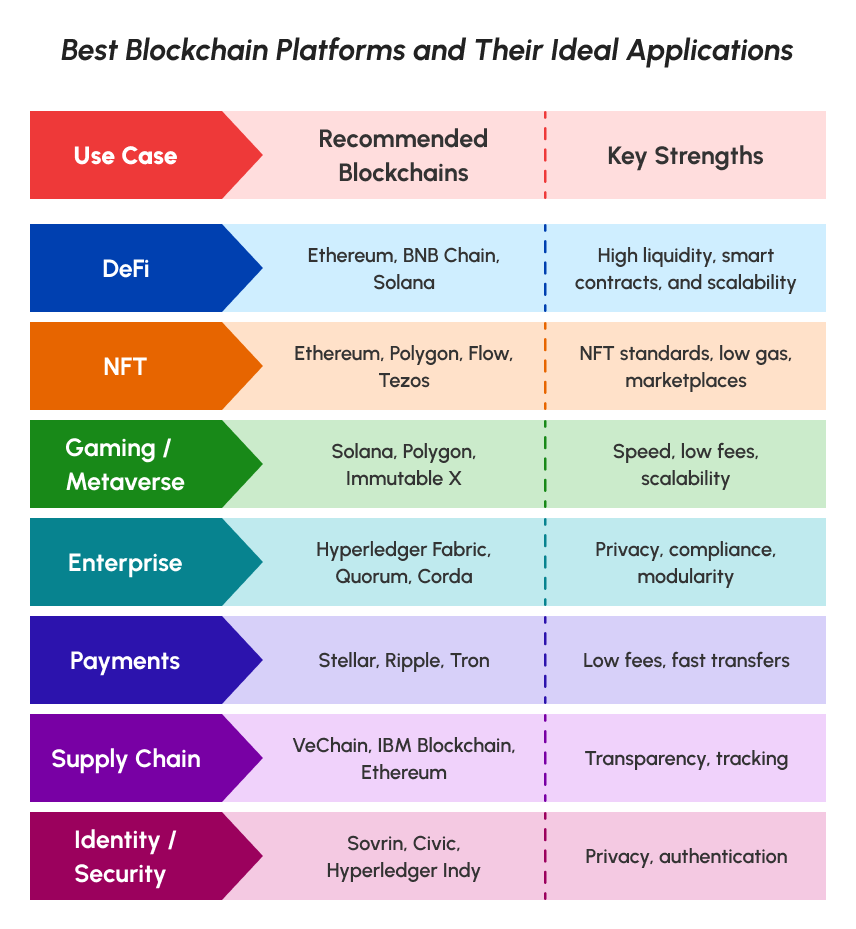
Now that you understand the different purposes of each blockchain, the next important consideration is to determine how you will choose the right blockchain for your project, depending on the project goals, scalability, and budget.
How to Choose the Right Blockchain for Crypto Token Development?
Choosing the right blockchain is a big factor that will decide if your project will be a success, have great scalability, and be cost-efficient. With a large number of platforms out there, it is very much necessary to pinpoint the main factors that affect the performance and compatibility before locking in on a particular blockchain network.
- Transaction Fee – Pick a blockchain with reasonable fees, as high fees can drive up the operating cost of your project.
- Transaction Speed – Fast confirmation times are of utmost importance, especially for DeFi, gaming, or payment applications, as they provide a seamless user experience.
- Scalability – The platform should be able to support and accommodate increasing transaction load and more users while maintaining a quality experience.
- Smart Contract Support – Necessary for automating functions, as well as operating DeFi protocols, NFTs, and
- Consensus Mechanism – Security, decentralization, and energy efficiency of the blockchain are all determined by this.
- Ecosystem & Community Support – The presence of a strong developer community and existing infrastructure not only keeps it easy for the project but also brings down the development time significantly.
- Reputation & Security – Security and reliability that are proven are important factors in building trust with both users and investors.
These points serve as a guide, but having the right technical skills is still the main part of the process if needed. Blockchain development Company brings experience, community best practices, and customized solutions to the table.
They help you in your own project, avoid expensive mistakes while also scaling efficiently and safely to launch your project. Don’t allow time and effort on a project; rather, hire an experienced team to build your blockchain vision into a secure and high-functioning application.
Launch Your Token on Leading Blockchain Platforms
Cost-effective, scalable, and secure token solutions across the top 10 blockchains.
Hire Expert Blockchain Developers from Coinsclone
Coinsclone is one of the major blockchain development companies available in the industry. Our team of blockchain developers provides you with a secure, scalable blockchain solution across various industries for crypto token development. With our blockchain solutions, you can create crypto tokens with enriched smart contract functionalities.
Our development team has 8+ years of experience and proven frameworks for creating crypto tokens that align with your token creation. Don’t rely on luck with your blockchain project; engage the experienced developers from Coinsclone, and you will get a secure, high-performance, and scalable final product that is exactly what you envisioned.
See How Our MVP System Can Power Your Blockchain Project Faster
Best Blockchain Platforms — built for speed, security & scalability.
- MVP System:Launch your blockchain network or dApp 90% faster.
- Modular Architecture:Plug-and-play smart contracts, wallets & APIs.
- Customization:Your consensus, your governance, your ecosystem.
- Revenue Engine:Monetize through staking, token sales, and transaction fees.
Get a free branded demo of your blockchain platform in just 48 hours — before you invest a cent.
Book a Free Demo to see how our Blockchain Development Framework takes you from concept to launch in 2–4 weeks.